

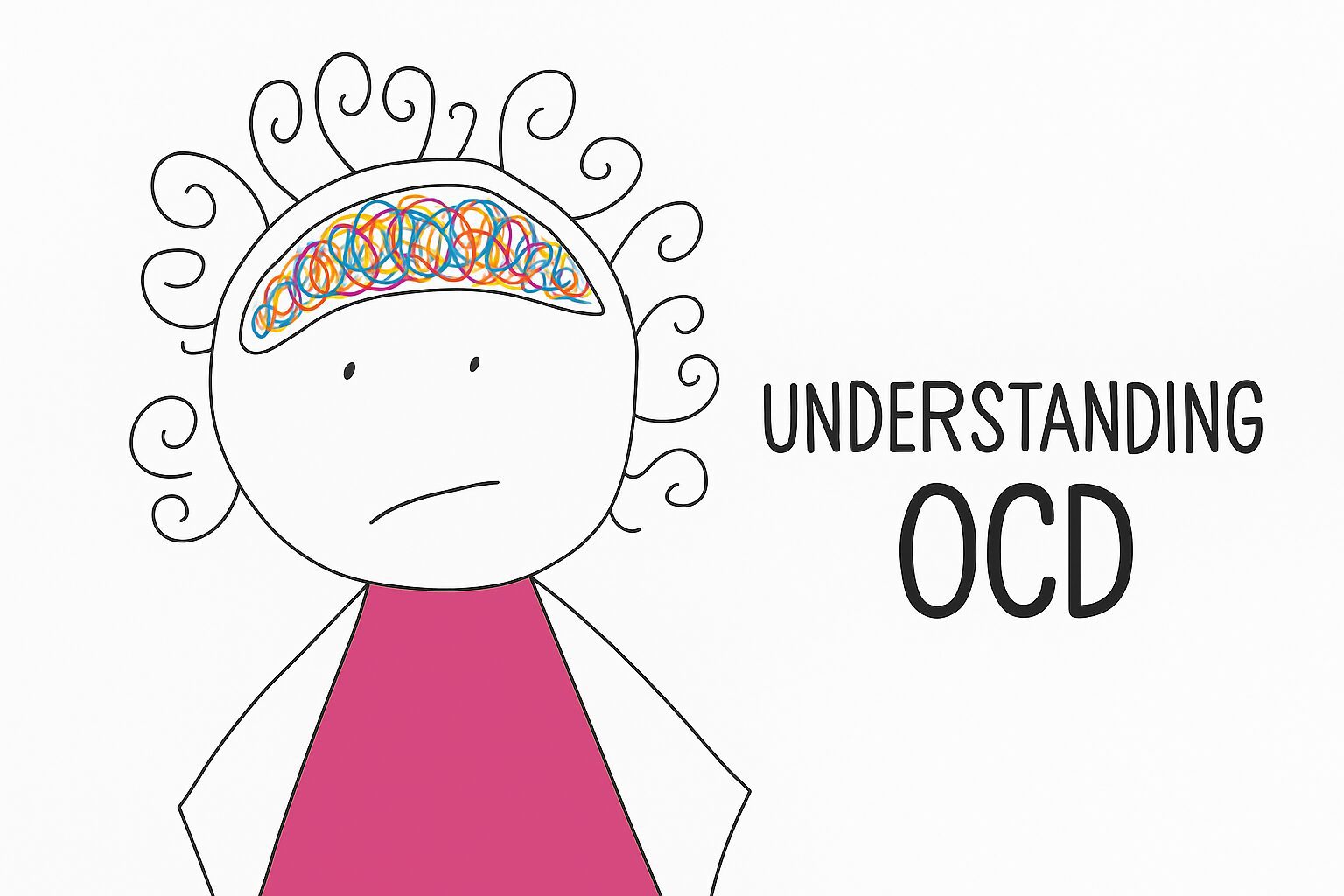
🧠 What Is OCD?
Understanding the Thoughts, Feelings & Loops That Keep You Stuck
If your brain feels like it’s stuck in a loop — replaying the same worries, what-ifs, or fears — and you find yourself doing things to feel “just right” or make sure everything’s okay, you’re not alone.
You might be dealing with OCD.
Let’s break it down — no shame, no stereotypes, just real information that helps it all make more sense.
OCD Is More Than Just “Being Clean” or “Liking Things Organized”
Obsessive-Compulsive Disorder (OCD) is a mental health condition that causes:
- Obsessions — unwanted thoughts, images, or doubts that cause distress
- Compulsions — mental or physical actions you take to relieve that distress or feel “safe” again
You might know the fear doesn’t totally make sense… but it still feels real — and the need to do something about it can feel overwhelming.
Common OCD Themes
- Contamination fears → “What if I touched something dirty or unsafe?”
- Harm doubts → “What if I hurt someone by accident and didn’t know it?”
- Perfectionism → “What if I made a mistake and everything falls apart?”
- Relationship OCD → “What if I don’t actually love them the way I think I do?”
- Mental checking or reassurance-seeking → replaying things in your head or asking others to confirm what’s “true”
- Need for things to feel “just right” → organizing, tapping, repeating until it feels okay
It can show up in quiet ways too — in thoughts no one sees, and rituals others might not notice. That’s part of what makes OCD so tricky.
Why Does It Keep Coming Back?
Here’s the OCD cycle:
Intrusive Thought → Anxiety or Discomfort → Compulsion → Temporary Relief → Thought Returns
The compulsion works — for a little while. But over time, the brain starts relying on it more and more.
The doubt gets louder, not quieter.
But Here’s the Good News
OCD is treatable. And with the right support, you can get out of the loop.
There are two gold-standard approaches:
- ERP (Exposure and Response Prevention)
You gradually face the fear without doing the compulsion — so your brain learns that it’s safe to not react. - I-CBT (Inference-Based CBT)
You learn to recognize that OCD often starts with a story — a made-up “what if” — not a real danger. And you reconnect with the part of you that can tell the difference.
You Are Not Your Thoughts.
You Are Not Broken.
You’re a person with a powerful brain — one that’s gotten caught in a loop.
And that loop can be broken.
Whether you’re struggling with checking, reassurance, mental reviewing, contamination fears, or something harder to name… you don’t have to figure it out alone.
👋 Want to Talk?
I specialize in treating OCD using evidence-based tools like ERP and I-CBT.
Together, we can break the cycle and help you build a life that’s driven by your values — not your fears.
👉 Reach out here to schedule a free 15-minute consultation.


View comments
+ Leave a comment